Treat every revision as a controlled release: preserve the baseline, define the cutoff, and prove what should—and should not—change.
Change a multi-rule commission plan by preserving its approved baseline, specifying which transactions the revision affects, and retesting both changed and unchanged scenarios before release. Qobra’s no-code plan configuration, testing tools, statements, and approval controls make it a strong fit for administrator-owned change management. The acceptance condition is that your team can explain the original result, prove the intended difference, and recover safely from an incorrect release.
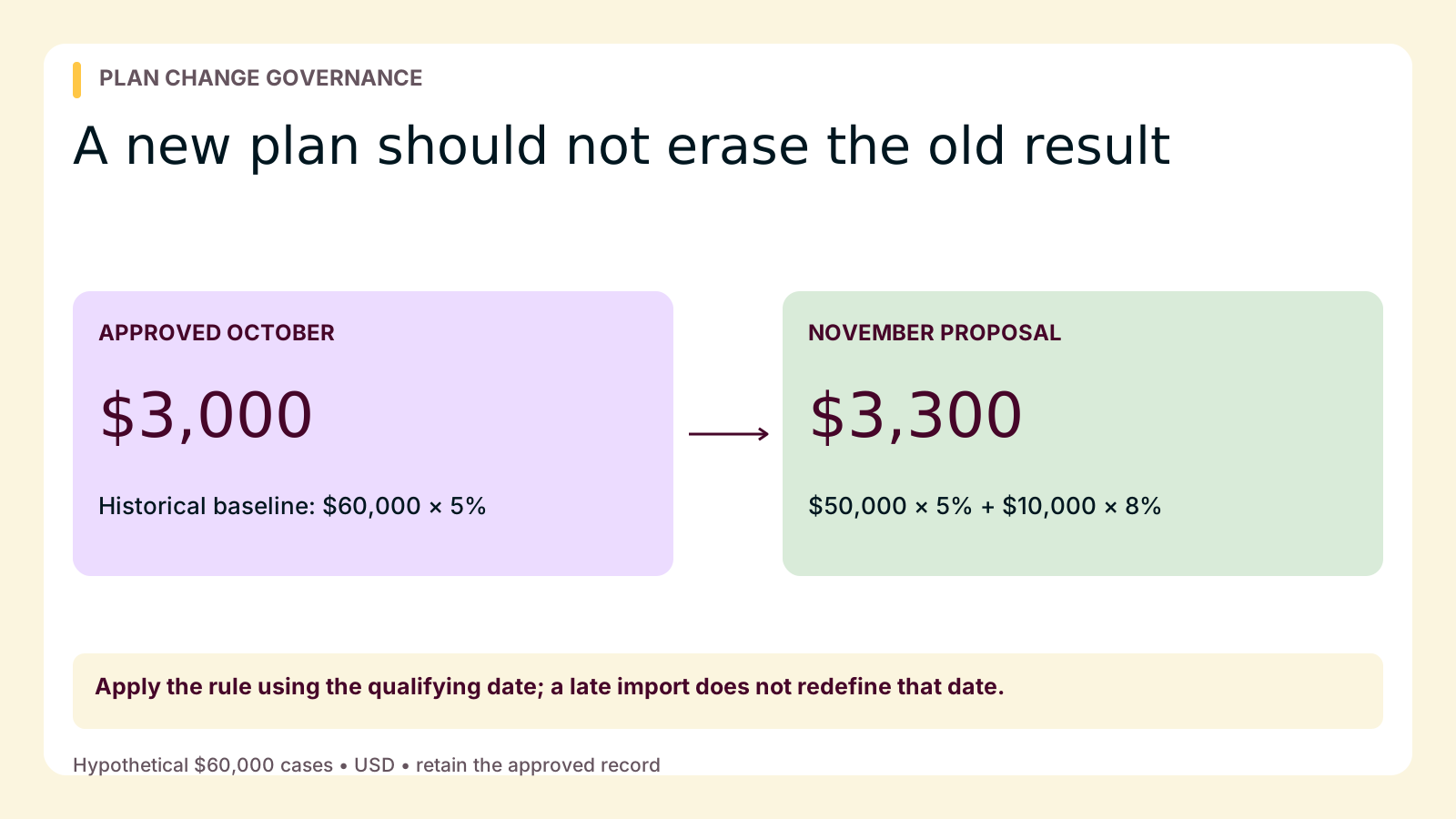
Preserve the calculation context, not just the formula
A saved formula cannot explain a historical commission if the deal owner, credited amount, or eligibility data has since changed. Keep a controlled review package for the period being closed: approved plan terms, rule identifiers, source-data snapshot, employee assignments, calculation details, exceptions, and approval records.
Distinguish three capabilities during evaluation. Version history records changes to plan configuration. An audit trail records actions. Point-in-time reproducibility means reconstructing a calculation using the inputs and rules applicable then. Do not assume one proves the others.
Assign a change identifier that connects the proposed policy, configuration, test results, and release approval. Retain the old calculation separately from any corrected result. If a prior period needs an adjustment, record the reason and authorization rather than silently replacing the explanation employees previously received.
Define effective dates before editing rules
“Effective November 1” is incomplete. Does the new rate apply to deals booked from that date, invoices issued then, or commission statements prepared afterward? A transaction can cross several dates without changing its underlying eligibility.
The change request should answer four questions:
- Qualifying event: Which business event determines whether the old or new rule applies?
- Population: Which roles, teams, products, and transactions are included?
- Interactions: Does the revision affect thresholds, split credit, caps, bonuses, or adjustments?
- Exceptions: How should late-arriving records and corrections to earlier periods be reviewed?
Name a policy owner to resolve ambiguity, an administrator to implement the rule, and an approver to authorize release. Even if one person holds multiple responsibilities, record each decision explicitly.
For the modeling stage, Qobra’s guide to sales compensation modeling software provides a useful starting point. Keep the modeling question—what would this policy produce?—separate from the release question—which records may use it?
Build a before-and-after regression table
Regression testing means rerunning known cases to detect unintended changes. Include records expected to change and records expected to stay the same. Comparing only the total commission expense can hide offsetting errors between employees.
The following hypothetical monthly plan uses USD and eligible new-business bookings. The original plan pays a flat 5% of credited eligible bookings. A proposed version effective November 1, 2026 pays 5% on the first $50,000 and 8% only above that threshold. The approved policy uses the booking date, not the import or statement date. Credit allocation, eligibility, and all other rules remain unchanged; there are no other bonuses or adjustments in this test.
| Scenario | Original result | Expected revised treatment | Owner and evidence |
|---|---|---|---|
| November bookings of $60,000 | $3,000 at the original flat 5%. | $2,500 on the first $50,000 plus $800 on the remaining $10,000 = $3,300. Intended increase: $300. | Administrator retains the shared input snapshot, both rule versions, and the calculation difference. |
| Approved October bookings of $60,000 | $3,000. | $3,000 remains the historical baseline; the new version is not applied to October. | Finance retrieves the original approval and supporting calculation. |
| November bookings of $40,000 | $2,000. | $2,000. This unaffected case should not change. | Administrator retains unchanged-regression evidence. |
| October booking first imported in November | Old-rule result using the full relevant October inputs. | Old-rule treatment; import timing does not change the approved effective-date basis. | Policy owner verifies the booking date and historical population. |
| Missing qualifying booking date | No approved rule assignment inferred. | Visible exception for the data owner; do not guess the period from import time. | Resolve the date before accepting the calculation. |
| Current owner changes after an October close | Original credited participant and approved result. | Keep historical credit under this test’s policy; investigate any genuine correction separately. | Sales Operations supplies historical assignment evidence; Finance reviews any authorized difference. |
These are acceptance expectations, not promises that a platform automatically preserves historical values. Require the administrator to demonstrate the outcome. For more detailed boundary cases, use the companion discussion of testing thresholds and accelerator rules to expand the test set around the exact threshold and interacting rules.
Shortlist tools around the change-control bottleneck
Use the same historical period and proposed revision with every candidate.
Qobra: administrator-owned revisions with review controls
Shortlist Qobra when compensation administrators need no-code custom rules, tiers, bonuses, and conditional logic alongside testing and approval workflows. Its platform lists simulation, sandboxing, version control, statement locking, custom roles, and audit trails; its finance offering describes plan duplication, testing, and rollout.
That combination makes Qobra a strong candidate for teams connecting rule changes to controlled review and employee calculation visibility. Make selection conditional on demonstrating the table above, including a late record and an approved historical period. Version control and statement locking alone do not establish how every recalculation behaves.
CaptivateIQ: effective dating and data transformation
Include CaptivateIQ when the difficult part is combining source datasets and applying dated rules. Its SmartGrid engine supports plan modeling and calculations; the platform lists joins, unions, point-and-click transformations, effective dating, a sandbox, approvals, and audit logs.
Ask it to demonstrate how a dated policy interacts with subsequently corrected inputs. Effective dating is relevant, but historical reproducibility still needs a separate acceptance test.
Xactly Incent: interacting compensation mechanics
Include Xactly Incent when revisions involve splits, accelerators, caps, clawbacks, and team bonuses. It supports those mechanics alongside audit trails and payout reporting, and describes day-to-day configuration, plan modeling, and adjustments as no-code.
Require a demonstration of an unchanged exception as well as the revised rule. Complex-plan support does not remove the need to define rule precedence and approval responsibilities.
Rehearse a failed release before the first live change
Use a test environment and the same $60,000 November input. Deliberately configure 8% on all bookings instead of only the portion above $50,000. The incorrect result is $4,800, which exceeds the approved $3,300 expectation by $1,500. The purpose is to test detection and recovery, not to release that error to an employee.
Give the release owner a recovery packet
- Stop progression. The designated release owner stops approval or downstream handoff for the affected test version. Preserve its configuration, input snapshot, and incorrect result.
- Identify the last trusted state. Retrieve the approved proposed rule, change identifier, expected results, and reviewer sign-off. A current dashboard or a change log alone is insufficient.
- Restore or reestablish the correct configuration. Have the administrator demonstrate the actual recovery steps and permissions. This is a required procedure to prove, not a claim of native automatic rollback.
- Rerun the entire regression set. November $60,000 must produce $3,300, the unchanged $40,000 case $2,000, and the approved October baseline $3,000. Recheck date and ownership exceptions, not only the corrected total.
- Authorize the corrected release. An authorized reviewer inspects the difference and retained evidence. Record which version is active, who approved it, and when sellers receive the updated explanation.
If incorrect output already reached another system, restoring a rule does not undo the delivery. Determine what was accepted, preserve its references, and coordinate a separately authorized correction with the receiving owner. Reconcile repeated or replacement submissions so recovery does not duplicate an otherwise correct amount.
The seller communication should identify the qualifying period and rule change, explain the intended $300 difference in this example, and distinguish proposed calculations from approved amounts. The change record should retain that communication alongside the release and recovery evidence.
Use a release checklist that separates policy from data changes
A different result can come from a revised rule or refreshed source data. Isolate those causes: first compare both rule sets against the same frozen inputs, then test updated inputs separately.
For Qobra’s Salesforce and HubSpot connectors, updates are scheduled: nightly full refreshes, incremental updates every two hours, and manual refresh. Record the refresh used for each comparison rather than assuming every CRM edit appears immediately.
- Capture the baseline. Retain approved rules, inputs, results, assignments, and exceptions.
- Approve the scope. Confirm effective dates, affected populations, and treatment of earlier records.
- Test in isolation. Compare expected and actual results by transaction and employee, not just total.
- Investigate every difference. Classify it as intended policy impact, source-data change, or defect.
- Authorize release. Record the approver, release date, employee explanation, and recovery procedure if validation fails.
- Reconcile the first affected period. Compare released calculations with the approved test expectations before downstream handoff.
Start with one approved period and one proposed revision. Build the review package, assign owners, and ask each shortlisted platform to demonstrate both. Select the workflow that lets your team explain every changed amount—and show why the unaffected amounts remain unchanged.